-
Food for Wildlife
After three lean years, our oak trees finally produced a bumper crop of acorns last September. Forewarned by hordes of blue jays screaming from the treetops as they plucked ripe acorns from the oaks, I had to be careful on our steep trails not to slide on the fallen nuts that were more hazardous than…
-
Amazing Hooded Warblers
It’s a hot, humid day in mid-July, and a hooded warbler sings his clear, whistled “ta-wit, ta-wit, ta-wit, tee-yo” song. Because hooded warblers have one of the loudest and clearest of warbler songs, it can be heard a long distance, which may be why I can hear it despite a slight hearing loss as I…
-
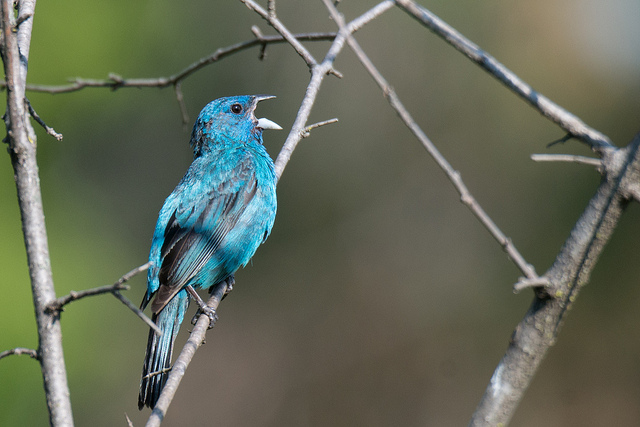
Blue Canaries
On an early May morning, I step outside and hear a warble of clear, bright, musical notes. The indigo buntings have returned. Also known as “blue canaries” because of their color and song, I’ve never been able to describe indigo bunting song to others except to say that I know it when I hear it.
-
The Waterfowl Itch
When I hear and see flocks of tundra swans flying northwest in early March, I get what I call the “waterfowl itch.” I want to visit as many lakes as possible to feast my winter-weary eyes on brightly-colored migrating waterfowl.
-
Midwinter Cranes
I never thought I would see sandhill cranes less than 20 miles from my home in central Pennsylvania. Yet there I was last January, sitting in our car with my husband Bruce, watching five sandhill cranes through our scope as they foraged in a small wetland near State College. When the word went out on…
-
The 114th Christmas Bird Count
The annual Christmas Bird Count is livened up by some extra counters, but inclement weather makes for a very challenging count.
-
Cavity-Nesting Birds
I’ve never thought of myself as a female Dr. Doolittle, but last June a bird “talked” to me and I understood her.
-
The Ides of March
For Caesar, it foretold the day of his assassination. For me, the 15th of March may be a bright, sunny day foretelling spring, a blizzard concluding winter, or, most likely, something in between. So it was on March 15, 2013.
-
Ghost Bird
A leucistic creature is white or pink all over, its eyes are usually blue, and it has little ability to produce color. Another source says a leucistic animal is not pure white, its pigmentation is diluted, and its plumage is lighter than usual but not pure white. David Bird, an ornithologist, recently defined leucism as…
-
Subscribe
Subscribed
Already have a WordPress.com account? Log in now.
 Marcia Bonta