Marcia Bonta

naturalist writer

Allegheny Front Hawk Watch

Marcia with Gene and Nancy Flament and Tom Dick (standing) at "the Ritz"

Marcia with Gene and Nancy Flament and Tom Dick (standing) at the bench Gene made--"the Ritz"

“It’s the Cadillac of hawk watches,” my husband Bruce said as we were leaving the Allegheny Front Hawk Watch.

Not only does it have a wide, grassy field flat enough for lawn chairs, a picnic table, and a portable restroom back near the parking area, but also a pair of platform benches, fondly called “the Ritz” by some visitors, positioned for optimal hawk-spotting.  What it doesn’t have are huge boulders to clamber over and perch on like many hawk watches in Pennsylvania.  For older folks like us, whose balance might not be as good as it once was, the Allegheny Front Hawk Watch is perfect.

I settled down on one of the benches at the edge of the mountain next to Gene Flament (the builder of the benches) and his wife Nancy and didn’t move for hours.  Above me, in the clear, blue sky of a breezy, early November day, raptors funneled southward.  With the Flaments, their son Randy, and the official counter of the day, Jim Rocco, we didn’t have to wonder what species any bird was no matter how high in the sky it flew.  These folks are all hardcore raptor watchers who were eager to share their knowledge with us.

Golden eagle taking off from a pine tree on Brush Mountain

Golden eagle taking off from a pine tree on Brush Mountain

Two golden eagles had already sailed past before our arrival, shortly before 10:00 a.m., and we hoped it would be a golden eagle day because when the wind is out of the east in November, as it was that day, adult golden eagles are numerous.  Below us, we could see the field where Trish Miller and Mike Lanzone, of the Powdermill Nature Reserve and Todd Katzner of the Aviary, had live-trapped and radio tagged two golden eagles for the first time in 2006. Since our mountain — the westernmost ridge in the ridge-and-valley province — is the alternate migration corridor for golden eagles in the fall, where Trish Miller trapped and radio tagged another golden eagle in 2007, we had wanted to see this particular hawk watch on the eastern edge of the Allegheny Plateau. (See my three earlier columns on the golden eagle trapping project: Golden Eagle Days (Part 1), Golden Eagle Days (Part 2), and Golden Eagle Redux.)

In quick succession, at 10:20, 10:21, and 10:38, three adult golden eagles soared past overhead, their golden crowns and napes visible on their mostly dark bodies. And that was it for us, but altogether nine golden eagles passed the hawk watch throughout the day.  Not an outstanding day for golden eagles at this hawk watch, which had as many as 51 on November 23, 2003, but with a seasonal average of 217, the chances of seeing at least a few on a November day are excellent. After all, as Tom Dick, the property owner, has said, “the golden eagle is the whole reason for the Allegheny Front Hawk Watch.”

Probably the best bird we saw was a northern goshawk that swept past at 12:30, its dark hood and white eyebrow line making it unmistakable.

“Oh, that’s a good bird,” Randy said, probably knowing that of the yearly average of 13 birds at this site, most are seen during spring migration in March and April and even then, four were the most seen on a day back on April 14, 2003.

Raptor i.d. signboard at the Allegheny Front Hawk Watch

Raptor i.d. signboard at the Allegheny Front Hawk Watch (click to see larger)

I was also pleased to have beautiful views of three of the 12 red-shouldered hawks that flew past during the day.  The first accompanied several red-tailed hawks, and all were lit up by the sun.  The second was high in the sky, its wings flapping, its neck craning.  But the third flew low and directly overhead, displaying its rufous belly and black and white tail.

As with other species we saw (two northern harriers and a sharp-shinned hawk), October is their peak month with 82 for red-shoulders on October 26, 2004. That day must have been a marvel for those watching because it was also the one that had the highest red-tailed hawk count (1,156).

We didn’t see that many red-tails during our visit, but it was a red-tailed hawk day. In fact, it was the first bird we saw when we arrived as one dove and screamed at the carved owl decoy displaying a couple ruffed grouse feathers atop a pole stuck in the grass. I lost count of red-tails after 30 because often there were three to five at a time in the sky, coming in from every direction as if they were converging for a party. We saw the larger females and smaller males, dark phase and light phase, most with white breasts and black streaks across their light bellies except for the dark phase with its dark brown breast and belly — 113 in all for us and 148 for the day.

Tom Dick and Randy Flament at the Allegheny Front Hawk Watch

Tom Dick and Randy Flament scan the sky for raptors

During lulls in raptor-watching, we admired the lovely panorama of fields and forests below. At 2,850 feet, the Allegheny Front Hawk Watch is the highest hawk watch in the state and looms 800 feet above the valley. Located in Bedford County on Shaffer Mountain near the Somerset County line, the property is owned by both Tom Dick and his wife Sally who generously open it to the public during spring and fall migrations.

Members of the Allegheny Plateau Audubon Society, centered in Johnstown, help to maintain the site and have been monitoring the fall migration from late August through November since 1989. On a clear day, such as we experienced, we could see as far north as Blue Knob, the second highest mountain in Pennsylvania, and as far south as the I-70 corridor. With my binoculars, I could watch for osprey over Shawnee Lake and spot the Dunning Creek Wetlands near Pleasantville in Bedford County.

The Dunning Creek Wetlands, a 170-acre nature sanctuary also owned by the Dicks, was created from a failed farm in cooperation with the United States Fish and Wildlife Service’s Partners for Wildlife program (now renamed Partners for Fish and Wildlife). Originally ditched and drained to raise crops, the farmland was often too wet to harvest and was abandoned in the late 1970s. By restoring the wetlands back in 1991, they attracted shorebirds and waterfowl in impressive numbers.  Once Tom Dick spotted tundra swans at the wetland from the Allegheny Front Hawk Watch and made a fast exit down the winding mountain road and back up the valley to the wetlands for a closer look.

Decoy for attracting saw-whet owls at night

Decoy for attracting saw-whet owls at night

Raptors aren’t the only migrating species that are counted at the hawk watch. Volunteers also count monarch butterflies and dragonflies and note the many songbirds they see there, both migrants and residents. A tent on the grassy field provides shelter for those banding migrating northern saw-whet owls. The evening before, Dave Darney had banded 20 of the little owls as well as one eastern screech-owl.

“The mountain is a major migratory corridor for saw-whets,” Tom Dick told us.

It also has the second highest count of spring migrating raptors after Tussey Mountain, which is the second most western ridge in the ridge-and-valley province and the mountain I see from the top of our First Field. From March until May volunteers also count raptors at the Allegheny Front Hawk Watch.

But in spring, some brave volunteers do more than monitor the raptor migration. They tie nylon ropes around their waists and are lowered down the steep mountainside to cut the brush and saplings for better viewing. Other volunteers keep the grass cut on top during workdays.

A weather station records wind direction and speed, all of which is carefully noted during hourly reports online to the Hawk Count site, maintained by the Hawk Migration Association of North America (HMANA), reports they’ve been sending in since 2002.

Visitors on a typical day at the Allegheny Front Hawk Watch

Visitors on a typical day at the Allegheny Front Hawk Watch

But the Allegheny Front Hawk Watch and the raptors they are counting, including the golden eagles, are threatened by the proposed industrial wind farm on Shaffer Mountain — ten turbines north 2.5 miles away and 20 turbines northwest 2.2 miles away. Miller and Lanzone’s golden eagle live-trapping site would be a mere 1.1 miles south of the nearest turbine.

These whirling turbines will be 400 feet high and threaten not only the raptors, but also the many migrating bats that use this corridor, bats that are already gravely threatened with extirpation, due to the white nose syndrome which is wiping out whole colonies throughout the eastern United States. The mountain has been designated a Pennsylvania Natural Heritage Area of Exceptional Significance because it has two of the highest-quality trout streams in the East, an endangered Indiana bat colony, and 11,000 acres of forest with only two dirt roads.

wind tubines on the Allegheny Front near Blue Knob, northeast of Shaffer Mountain

Wind tubines on the Allegheny Front near Blue Knob, northeast of Shaffer Mountain

More than 3,000 people have signed a petition opposing this particular site, and most wonder why a huge former strip mine, two miles from the proposed project, can’t be substituted for it, especially since the same company that proposes to level a pristine area of Shaffer Mountain owns the land. They reason that more than 100 wind turbines have been constructed on the same kinds of strip mines.  Why despoil an area with exceptional value streams, endangered bats, and the major flyway for migratory birds and bats.

Sadly, the wind companies aren’t waiting for the results of Trish Miller’s study of the effects of wind turbines on golden eagles — those turbines made of reinforced Fiberglass, weighing 3,000 pounds or more, and rotating as fast as 200 miles per hour at their tips. Even though wind companies claim that bird deaths are minimal, a turbine site at Altamont Pass in California kills on average 75 golden eagles a year.  Since our eastern golden eagle population is much smaller than the western one, such losses would soon wipe out what Miller estimates is a migratory population of 1,000 to 2,000 eagles.

Must we destroy the planet in order to save it?

Must we destroy the planet in order to save it?

Of course, the golden eagle is one of many raptor species that will be impacted by those spinning blades. And already there is an industrial wind farm on Blue Knob. Another one is slated, also on the Allegheny Front, above Tyrone, and directly across the valley from our home, even though Trish Miller has already discovered that golden eagles like to pause and feed on the Tyrone watershed site during migration.

So little is known about this species in the East that she and her husband, Mike Lanzone, are making new discoveries every year about the migration patterns of these birds that breed in northern Quebec and Labrador and migrate south for the winter to eastern Kentucky and southwestern West Virginia as well as to southern Pennsylvania. Unfortunately, by the time her study is completed, golden eagles and other raptors will have many more wind turbine blades to avoid.

Knowing all this, I found it difficult to believe that the industrial wind farm would be built on Shaffer Mountain. As Jack Buchan of Johnstown, a Shaffer Mountain landowner and member of Sensible Wind Solutions wrote in a letter to the Johnstown Tribune-Democrat, “If [the wind company] is permitted to build there — to degrade exceptional value streams and kill endangered animals — no place will be off-limits to the wind industry in Pennsylvania.”

Visit ShafferMountain.com for more on this ill-advised project, and to learn how you can help stop it and save the golden eagles. If you’re on Facebook, join the Save Shaffer Mountain group.

The second and the last two photos are by Dave Bonta; all others are by Bruce Bonta.

November 1, 2010 Posted by | golden eagles, northern goshawk, Pennsylvania Places, raptors, red-tailed hawk, wind turbines | , | 2 Comments

Nature’s Garbage Collectors

turkey vulture above First Field

A turkey vulture soars over First Field in Plummer's Hollow

Like residents of Hinckley, Ohio, who always welcome the first turkey vultures back on March 15, I too await the return of them in March and regard them as one of the first signs of spring.  Usually the day they appear here is windy, and they rock back and forth above First Field, their wings tilted in their distinctive V-shape, which enables them to soar and glide for hours without flapping their wings.

According to recent studies by raptor biologists at Hawk Mountain Sanctuary, most Pennsylvania turkey vultures have returned from Florida or Georgia, but others return from nearby southerly states.  Still others never leave the commonwealth, occupying roosts in southeastern and south central Pennsylvania counties.

Twenty years ago, in late January, I visited the large winter vulture roost at Gettysburg National Park. The center of vulture activity is focused on an area aptly nicknamed “the Valley of Death,” after the battle, although contrary to legend, the vultures did not first appear in the area to clean up the dead horses after the battle in 1863.  Turkey vultures were in the area long before then, and black vultures, previously living only south of the Mason-Dixon Line, didn’t emigrate there until the late 1930s or early 1940s.

Watching hundreds of vultures as they gradually entered the roost at night and vacated it at first light, was a memorable experience.  No wonder Jim and Shannon Lang of Tyrone were excited when vultures chose their 27-acre, wooded property as a seasonal roost in 2006.  Located on a hill above the wooded town park, with houses on side of them, their 1930s-era house and their pool were shrouded with trees that darkened their prospect.  Shortly after moving in, they cut down 25 large trees, and the next year the vultures arrived in March.  They hang out in the four acres of open woods around their house and garage and beyond their pool.

turkey vultures at Gettysburg by Henry McLin

Turkey vultures at Gettysburg by Henry McLin (Creative Commons BY-NC-ND licence)

“They seem to have three or four favorite trees,” Shannon says.  “I call those trees the Radisson.  When they are filled, they go to smaller trees — the Motel 6.”  Those trees are mostly oaks and conifers.  That habitat — partially open under a canopy of large trees to give the vultures room to move around in — is perfect for a vulture roost.  And in southern Pennsylvania, northern Maryland, and northeastern Virginia, according to a study, roost sites were closer to clearings, human residences, roads and permanent streams than roosts in other parts of the United States.  That perfectly describes the habitat of the Lang’s roost because there is a stream on their property and in the park below.

Shannon, who has a degree in wildlife biology, enjoys watching the vultures even though her neighbors think they are spooky and wonder why she doesn’t get rid of them.

“I think they’re fascinating,” she says.  “They add to the wildlife. I like to see them in the morning when,” she tells me, “they are off by 7:30 and back around 7:20 in the evening. You could almost set your watch by them.”

She adds that they are quiet and clean.  Her two sons collect the pellets the vultures cast below the trees, gagging them up while they lie in a horizontal position, their bodies hanging down and heads bobbing.

Shannon has even watched the vultures play.  Once, when their pool was still covered, a turkey vulture landed on it and using its beak, tried to roll a large ball that her sons had left on top of the cover up a slight incline.  Each time the ball rolled back down to the vulture and it tried again. Apparently, its antics kept the entire family entertained for quite a while.

A turkey vulture basks in the last rays of sun before going to roost above a rockslide on Brush Mountain

A turkey vulture basks in the last rays of sun before going to roost above a rockslide on Brush Mountain

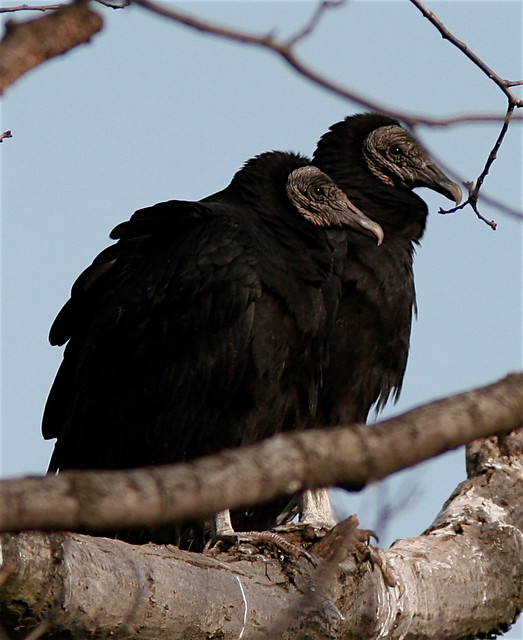
The Lang’s roost is a seasonal one and is made up mostly of turkey vultures with a couple black vultures and has about 52 birds.  These communal roosts — winter, seasonal, or year-round — can range from a few birds to several thousand, although the largest are winter roosts because both residents and migrants occupy them.  The one at Gettysburg National Park has held as many as a thousand vultures and those in Florida more than 4,000.

Such roosts are probably used to escape predators, provide opportunities for various social interactions and supply meeting places for possible mates.  But surprisingly little is known about the life history of these common birds.  For instance, researchers believe they mate for life, but they aren’t certain. They also don’t know at what age turkey vultures mate for the first time, but they do suspect that less than half of most populations breed in a year.

Here in Pennsylvania, turkey vultures arrive in early to mid-March, and most eggs and nests are found between April 18 and May 14.  But turkey vultures are secretive nesters, and while researchers think they nest throughout the state, during the first Breeding Bird Atlasing, only one per cent of observations were those of nests.  That’s because the females usually lay their one to three, creamy-white, blotchy eggs in deep recesses such as caves, crevices, and ledges, in mammal burrows, cavities in banks, or in large, hollow logs. Once they find a good nesting area, they often reuse it for long periods.

A mated pair frequently sit together near their nest site for days or weeks before nesting and engage in what researchers call “Follow Flight, something I’ve observed over First Field, when one bird flies behind and above the leading bird, often twisting and turning just as the leader does.  Sometimes the trailing bird dives at the leading one, partially folding its wings and diving directly toward it while the leading bird twists sideways and drops and the trailing bird flies upward again, neither bird touching the other. Other displays, such as ritualized “dancing,” bill-gaping, and wing-spreading have also been observed by researchers before the birds mate on the ground, rocks, or in trees while nibbling or poking at each other’s naked, red heads.

After the female lays her second egg, she and her mate take turns incubating them. It takes between 38 and 40 days for the eggs to hatch young that are downy with naked faces, throats, and crop areas. The parents also take turns brooding them until they are two weeks old and feed the young by regurgitation. By 18 days of age, they are able to stand up and retreat into the recessed nest to escape predators.  They can also stomp their feet, hiss, and perform what ornithologists call “Scare Jump” or “Scare Rush,” when they lunge forward, their heads thrust upward, flap their wings, open their bills, and hiss in a bluff attack.  Such an attack was enough to turn my Uncle Cal permanently against “buzzards,” as he called them when he told me about crawling into a cave outside Pottstown when he was a teenager and meeting the “Scare Rush.”

T.V. chick on a nest in a hollow tree in Michigan, by David Allen

T.V. chick on a nest in a hollow tree in Michigan, by David Allen (Creative Commons BY-NC-SA)

Between 70 and 80 days of age, nestlings become fledglings, flying above the canopy, and leave the nest area for communal roosts when they are 12 weeks old, about the time in August when the Lang’s roost increases in size for a few weeks before the vultures are gone for another year.

Turkey vultures are unique among vulture species because they can smell as well as see their prey, which is why black vultures often follow turkey vultures to a carcass and then bully them away from it.  One early May day, as I approached the Far Field, I spotted a turkey vulture in a tree that spread and shook its wings but remained on its perch.  One of our turkey hunters had told me about a dead deer there.  Then, I noticed a second turkey vulture in the same tree while a third wheeled overhead. After a few minutes, the first vulture soared off.  Suddenly, a black vulture flew up from the ground, sat in a tree a short time, and flew back down on to the dead deer hidden in the grasses below. After picking at the carcass for a few minutes, it flew up to the remaining turkey vulture and chased it away.  Then it too flew off.  Although black vultures are a little smaller than turkey vultures, they always dominate them.

The scientific name for turkey vulture is Carthartes aura, which means “breezy purifier.”  As primarily scavengers, the pH of a vulture’s stomach acid is an incredibly corrosive zero, which allows them to eat rotting flesh that might contain anthrax or botulinum.  In addition, they use it as a weapon projectile, vomiting on any potential predator.  As if that weren’t disgusting enough, they also defecate on their legs because the high ammonia content of their feces, ornithologist David Bird says, probably “kills off potentially harmful microorganisms picked up while standing in and wading through rotting carcasses.”

Such food can most easily be found in a mixed farm and forest habitat such as we have in our area.  There they eat the carcasses of both wild and domestic carrion such as livestock, woodchucks, skunks, raccoons, opossums and deer.  In fact, turkey vultures only moved into Pennsylvania’s wooded mountains in the 1920s and 30s to feed on starved deer.  A study of turkey vulture pellets in North Carolina also found Bermuda grass, pieces of plastic sandwich bags, brown paper sacks, and polystyrene in them, which proved that turkey vultures clean up road kills.  Without them, we would have many dead critters around.

They also hang around landfills, as Keith Bildstein of Hawk Mountain Sanctuary and James Mandel of Cornell University discovered.  They spent 120 days in 2004 and 2005 watching turkey vultures from an unused hilltop at Waste Management, Inc. Landfill in Pen Argyl, Northampton County.  The 30 to 90 turkey vultures that fed there roosted at three nearby communal roosts.  Of those vultures, 10 to 15 stayed 90 to 210 minutes after the local sunset while turkey vultures that fed in nearby farmlands, woodlands, and suburban areas returned to their roosts no later than 30 minutes after sunset. Those vultures that remained at the landfill used hot air thermals caused by two methane venting sites to give them lifts to leave the landfill long after natural thermals had subsided for the night. However, landfill workers found turkey vulture carcasses at or near the base of the vents which suggests that the flares killed them by suffocation or scorching.

Turkey vultures with a roadkilled opossum

Turkey vultures with a roadkilled opossum in Missouri, by Auntie G (Creative Commons BY-NC-ND)

Bildstein and other raptor biologists at Hawk Mountain Sanctuary launched a long-term study of turkey vulture migration in 2003 to, in their words, “learn more about the extent, causes, and consequences of their annual journeys.” They put tiny radio tags monitored by satellite on 24 turkey vultures in order to study both their autumn and spring migrations. According to raptor biologist, David Barber, who is working on this study and recently spoke to our local Juniata Valley Audubon Society, four of eleven turkey vultures that he studied were migratory.  Those that migrated went to Florida and Georgia, but while some go to the same place every year, others seem to adjust to the weather.  They don’t always take the same route.  Some migrate along the coast.  Others go down the Appalachian spine. Pennsylvania birds take a month to migrate making many stopovers and waiting for the thermals to waft them south.  By implanting five vultures with heart-rate loggers, the researchers discovered that they don’t use very much energy to migrate.  The wind does all the work.

Today turkey vultures are a  continent-wide, common species, and Hawk Mountain scientists want them to remain so, unlike the incredible decline of Old World vultures in many parts of Africa and southern Asia, especially in India where an anti-inflammatory drug given to cows has caused kidney failure within 36 hours to vultures that have scavenged the bodies of cows containing the drug. The population fell from 40 million in the 1980s to a couple thousand today, “the most catastrophic decline of a raptor species anywhere,” Bildstein says.

Maybe we should all celebrate the second International Vulture Awareness Day next September 4. It grew from Vulture Awareness Days run by the Birds of Prey Working Group in South Africa and the Hawk Conservancy Trust in England.  I was also pleased to learn about the Turkey Vulture Society, a nonprofit scientific corporation whose “purpose is to promote scientific studies of the life habits and needs of the Turkey Vulture, to protect the vulture and its habitat, and to inform the public of the valuable and essential services this bird provides to mankind and to the environment.”

Turkey vultures heating up in the early morning sun by Linda Tanner

Turkey vultures heating up in the early morning sun by Linda Tanner (Creative Commons Attribution licence)

The two unattributed photos are by Dave Bonta. Click on any of the other photos to view at Flickr.

March 1, 2010 Posted by | Animal Behavior, Biologists in the Field, Brush Mountain/ Plummer’s Hollow, Pennsylvania Places, raptors, turkey vulture | , , | 7 Comments

Follow

Get every new post delivered to your Inbox.

Join 305 other followers